
Bug Powder Dustin'
Bomb The Bass, William S. Burroughs and the anatomy of a bass line

“I think it’s time to discuss your philosophy of drug use as it relates to artistic endeavours”
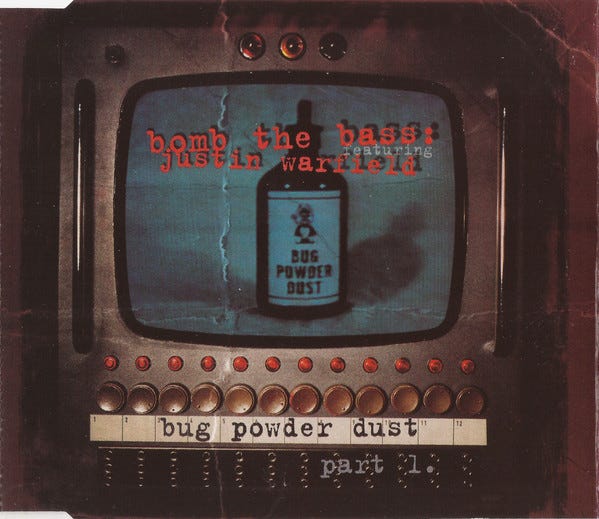
Bomb The Bass & Justin Warfield threw out a track 31 years ago that is largely forgotten now, but in the original form and in various iterations and interpretations blazed a trail in the conciousness of 1990s music - it was hip hop, it was big beat, it was trip hop, and it was *very definitely* a trip. That track was Bug Powder Dust:
Tim Simenon aka Bomb The Bass is one of the unsung heroes of UK music culture, and for a short while at the back end of the 1980s was a pretty big star. He surged into the pop charts in 1987 with “Beat Dis” a slamming concoction from that fertile era in the UK when dance music was still forming and mutating in the scalding soup of creation. Influences were bouncing back and forth between the UK and the USA producers like Bomb The Bass, S’Express and M/A/R/R/S/ were taking cues from Chicago House and Detroit Techno and then smashing them up with the densely packed sampling philosophy of hip hop producers like Public Enemy’s Bomb Squad.
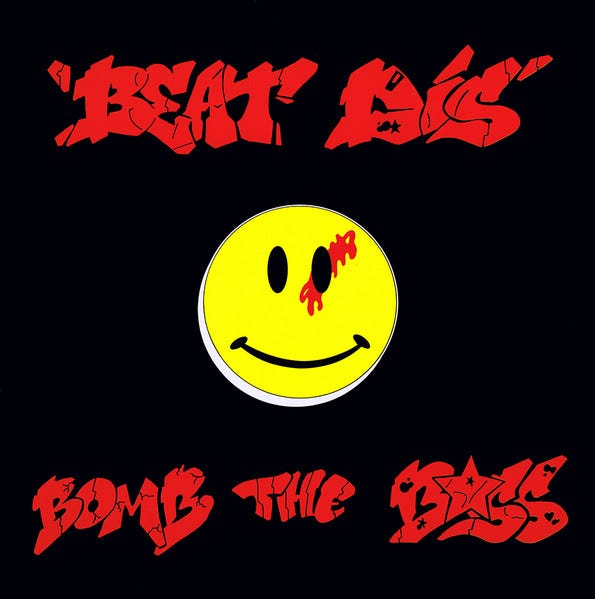
Beat Dis, Pump Up The Volume and The Theme From S’Express were massive hits and it was wild west days when producers just threw every sample in the pot - “Beat Dis” has 70 different samples, (though the lawyers caught up with them in the end). It’s also notable for bringing the acid house smiley ( originally from Alan Moore’s Watchmen) into the wider consciousness.
The “Into The Dragon” album eight months later had two more big singles - the double A side “Don’t Make Me Wait / Megablast” and “Say A Little Player”. The 1991 follow up “Unknown Territory” enjoyed success as well, the biggest single “Winter In July” shares sonic similarities with Massive Attack and Coldcut’s work at that time. In 1995, in what would turn out to be their last output for over 13 years, Bomb The Bass released “Clear”, one of the great forgotten “Trip Hop” albums (more about that genre here). Listening back now, on one level it is very much a record of it’s time, but there is a tremendous line up of guest appearances and most of the tracks still stand very tall, like the booming dub of Dark Heart with a vocal for the ages from Spikey Tee:
Also featuring on the record programming synths and with a couple of co-writing credits is Atticus Ross, (who you’ll now know as one of the leading soundtrack composers in Hollywood). Album closer “Empire” has an added layer of poignancy, the now both sadly departed Sinéad O’Conner and Benjamin Zephaniah deliver a sonorous, haunting indictment on faded and brutal British imperialism. A track that still reverberates 30 years later.
But the often serious tone of much of the rest of the record is absent in the opener “Bug Powder Dust”. For that track Simenon had discovered the unique stylings of Justin Warfield; whose 1993 debut “My Field Trip To Planet 9” fused West Coast psychedelia with East Coast golden era bumps to magnetic effect:
Warfield got a call from Simenon and as a committed musical anglophile was already well aquainted with the music and came over to London to lay down the vocals. When arriving in the studio and there were various VHS boxes lying around including “Blade Runner” and “The Naked Lunch”, (directed by David Cronenberg and starring Robocop’s Peter Weller), and that serendity secured the theme of the song and the spoken word sample at the start.
His previous lyrical content had been full of nods to the hippy culture of California and San Francisco - but for this track he went full bore in homage to the leading light of the Beat Generation, William S. Burroughs. The lyrical delivery and the context of the time have a lot in common with the Beats, like much of their work it’s a structured stream of consciousness that broadly maps on to the events of Burroughs short and wildly controversial second book: “I'm like Bill Lee writing when he's in Tangier's / And now I'm on a soul safari with my Beatnik peers” - Bill Lee being Burrough’s alter ego and protagonist of the “The Naked Lunch” and Tangiers was where much of the book was written.
The lyric is a sack full of references, in particular to 60s psychedelia - a movement that undoubtedly took its cues from that mind expanding Beat Generation of the 50s. It’s full of nods to The Doors, The Beatles, Led Zeppelin. That said it isn’t always thematically consistent, there are disconnected references to the 80s, like Men At Work, Wes Craven and even Fast Times at Rigemount High. If Truman Capote read the lyrics he might have repeated the same withering criticism he made of Jack Keroac “That’s not writing, that’s typing”. But where Warfield’s lyrical content has common cause with the Beats, is it’s all about the style, the vibe and the sound of the words, and the words are a lot of fun. “Bug Powder Dust” is an halucinagenic drug extracted from beetles by the novel’s protagonist, “Mugwump” is a sort of humanoid lizard creature, and you know what “Jism” is.
The other striking thing about the track is of course that bass line. The bass is from Brazillian Jazz singer Flora Purim’s 1976 track “Open Your Eyes, You Can Fly”. The bass player was Alphonso Johnson - a jazz fusion band leader in own right and also a member of Weather Report. In the 80s Johnson went on to play with Santana and on Phil Collins first album. But Simenon didn’t get to the bass line first, DJ Food got there in 1993 with “Dark Lady”
The story goes that Simenon heard it on the DJ Food track and then adapted it for “Bug Powder Dust” - but, the bass isn’t the Alphonso Johnson / Flora Purim sample - it’s actually replayed by legend Doug Wimbish - bassist on “The Message” by Grandmaster Flash, member of The Sugarhill Gang, Living Colour and industrial pioneers Tackhead (Wimbish also plays on Empire and co-wrote Sandcastles from the “Clear” album).
In some senses the track took on an even bigger life with the alternative versions - in what was probably the grand epoque for remixes - and some great producers tackled “Bug Powder Dust”. The Chemical Brothers, and La Funk Mob (the Hip Hop inflected alt of Cassius), both had memorable and wholly different takes on the track. Cypress Hill’s DJ Muggs turned out a head nodding bumper of a version. The one that probably became as well known as the original was The Kruder and Dorfmeister Session, (that originally appeared on the 12” / CD single of Sandcastles, and where I first discovered K & D). My longtime DJ partner Sam / 3DJ rooted through a history of vinyl records and joined the dots between K & D, DJ Food and Bomb the Bass on this Mix.
Bomb the Bass was only a small part of Simenon’s work, much of it was behind the scenes as a producer, working on Neneh Cherry’s iconic “Raw Like Sushi” album. He also reworked Bjork’s Play Dead adding the stomping beat to the original cinematic composition to create the version everyone knows. He was a producer for Sinéad O’ Connor and on Depeche Mode’s Painkiller LP - which introduces another Kruder and Dorfmeister connection, the iconic bass of Useless definitely has a stylistic link to Bug Powder Dust and is retained in the original and the remix. Bomb The Bass were reactivated for a while in the late 2000s and the music was still pretty great and enlisted outstanding collaborators like Fujiya and Miyagi on the 2008 album “Future Chaos”:
When I was researching this article I fully expected to find a plethora of productions with his fingerprints all over them from the last 20 years - those innovators of the late eighties still cast a shadow across music to date. To my surprise I found that he’s basically jacked it in, and hasn’t produced anything for over a decade, moving to Prague and running a restuarant for a number of years. When interviewed in 2022 he said “I kind of feel I’ve done the thing with the music,” “I was doing it for 25 years, and I would find it difficult to see myself going back into that. The idea of getting back into the studio… I’m not sure. I never say never but, at this moment, I’m looking at new things that are outside of music.”
“The Naked Lunch” ushered in the 60s and a bohemian cultural era set against the backdrop of the Cold War. 30 years after that when “Bug Powder Dust” came out, the Cold War was over and a new epoch of counter culture was shifting the paradigm once again. 30 years further on the world looks on open mouthed as autocrats, techbros and fascists overrun civilisation as we knew it with a jump and a wink. The counter culture dream seems like it’s fading away. Maybe it’s time for Bomb The Bass to make a comeback, because every dsytopian horror needs some good tunes, right?
Another fantastic piece. I like it. I like it a lot. Thanks for the name/mix check too! Since hearing Bug Powder Dust way, wayyyy back, it’s always been a fascination of mine not just for its intricacies laid out here but for the sheer amount of ‘chillouts’ it’s soundtracked over the years.
For me, it remains right up there... Pete n’ Rich must have seemingly built that whole set around it. Hard to believe it’s coming up on 10 years since I put together The K&D Sessions Re-Visited. Gonna give myself another listen!
That whole sampling ethos of the late '80s and early '90s is something I’ve always indulged in as a fan. Sample it, Loop it, Fuck it & Eat it... Right? A mindset for the counterculture.
The whole cut-and-paste aesthetic underpins my all-time fave act. In fact, not only did PWEI sample Beat Dis (heavily), but it’s pretty much the blueprint for Def. Con. One. They both charted the same year, but digging deeper, Def. Con. dropped about six months after Beat Dis was officially released ...though it seems PWEI were already playing DC1 live and must’ve got a hold of the original ‘87 pressing when putting together This Is the Day...This Is the Hour...This Is This!
"Watchmen - We love you all" tying the two tracks and Alan Moore together forever 🙂
Simenon was effectively creating the future sound of what would become 'Big Beat', while the Poppies had already coined their sound - Grebo. Must’ve been a mad, heady time to be producing DIY music, physically piecing everything together rather than plucking it out of the digital ether.
But I digress. Back to the Jism it’s wild to think how far-reaching this track remains.... a smashing piece, Chris. Maybe it is time for Bomb The Bass SOUND to make a return after all, every dystopian horror and evil overlord does deserve a killer soundtrack = problem is, they’re just middle-aged men with silly haircuts.
Give me Bobby Vylan these days.
One of the all-time great basslines. I never had any idea what the rap was banging on about, and assumed that I was mishearing 'mugwamp jism'.
Bomb The Bass was probably my gateway into dance music, although I was too young to really know at the time. Me and my Bro were aways listening to Into The Dragon, partly because Beat Dis was such a jam, but also because Megablast featured heavily on the soundtrack to the Bitmap Brothers' classic shoot 'em up Xenon 2: Megablast.
https://www.youtube.com/watch?v=KFlCTJPWpcw
The first game to feature an actual song on its soundtrack rather than simply 8-bit bleeps? Paving the way to the irrevocable and symbiotic relationship between music and gaming? Precursor to the likes of Wipeout, Tony Hawks, et al? Dunno, actually, but definitely in with a shout.